
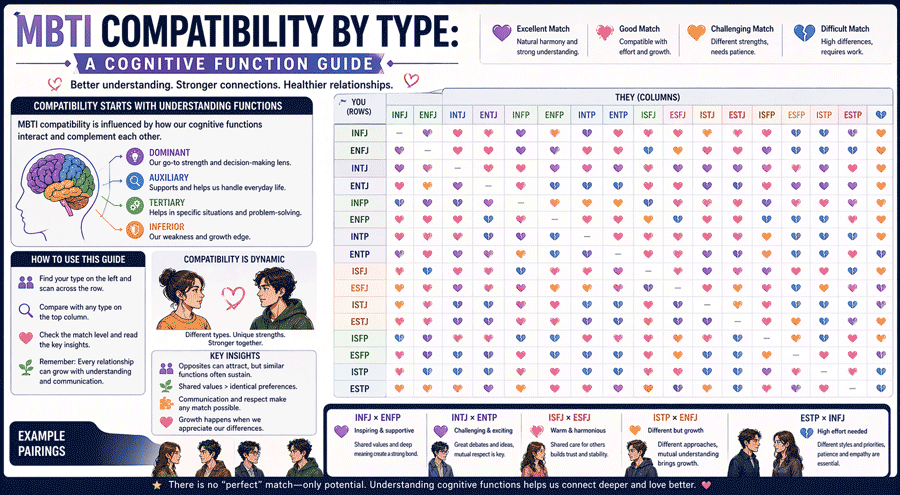
Understanding mbti compatibility by type is less about matching four-letter codes and more about analyzing how cognitive functions interact between individuals. While many seek a simple chart telling them who they should date or work with, the reality is that meaningful compatibility stems from understanding psychological preferences, communication styles, and growth potential. At Persona Key, we believe that MBTI type is a starting point, not an endpoint. To truly grasp why certain relationships thrive while others struggle, you must look beyond the letters and explore the underlying cognitive machinery.
This article provides a deep dive into the mechanisms of personality compatibility. We will move past stereotypes to offer practical frameworks for validating your type, navigating relationships, and fostering personal growth. Whether you are seeking romantic harmony, better workplace collaboration, or self-understanding, the key lies in recognizing how different mental processes complement or clash with one another.
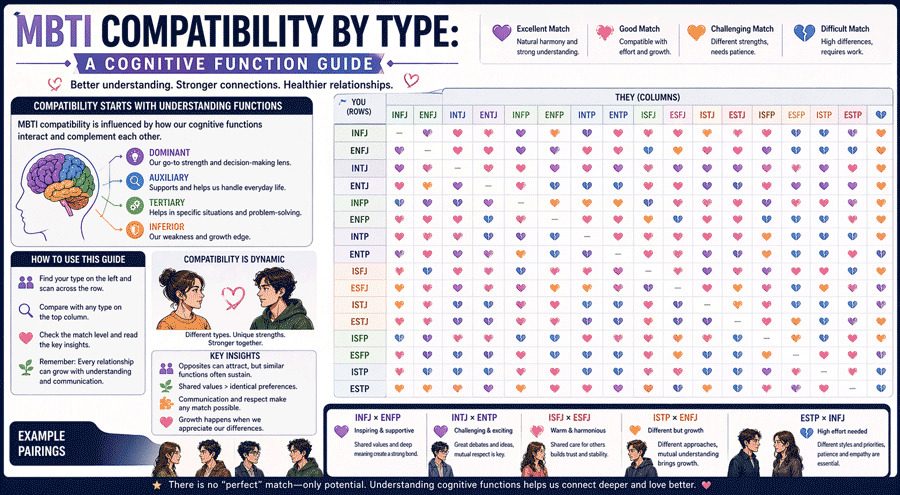
The Mechanism Behind Compatibility
To understand compatibility, we must first understand the engine of the MBTI system: Carl Jung’s theory of psychological types. The Myers-Briggs Type Indicator (MBTI) was developed to make Jung’s complex theories accessible, but in simplifying them, much nuance was lost. The four letters (e.g., INFJ, ESTP) are merely indicators of a deeper stack of cognitive functions.
Jungian Roots and the Four Dichotomies
The MBTI sorts preferences into four dichotomies: Extraversion vs. Introversion, Sensing vs. Intuition, Thinking vs. Feeling, and Judging vs. Perceiving. While helpful for broad categorization, these letters do not explain how a person processes information. For instance, two Introverts may behave vastly differently because one leads with Introverted Thinking (Ti) and the other with Introverted Feeling (Fi).
Compatibility issues often arise when people focus solely on these letters. An INFP and an ISFP share three letters, but their dominant functions (Fi vs. Fi with different auxiliary functions Ne vs. Se) create different worldviews. Conversely, an INFP and an ENTJ share no letters, yet their function stacks are mirror images, often creating a powerful “golden pair” dynamic based on complementary strengths.
The Cognitive Function Stack
Every type has a stack of four functions that dictate their mental hierarchy:
- Dominant Function: The hero role. This is the primary lens through which you view the world. It is natural, effortless, and defines your core identity.
- Auxiliary Function: The parent role. This supports the dominant function, providing balance. If your dominant is introverted, your auxiliary is extraverted, and vice versa.
- Tertiary Function: The child role. This is less developed but often a source of comfort or creativity. It can be a playground for relaxation.
- Inferior Function: The aspirational role. This is the weakest link, often emerging under stress. It represents what you aspire to be but struggle to integrate consistently.
When analyzing mbti compatibility by type, you are essentially analyzing how one person’s dominant function interacts with another’s auxiliary or inferior functions. For example, an INTJ (Ni-Te) may appreciate an ENFP (Ne-Fi) because the ENFP’s extraverted intuition feeds the INTJ’s introverted intuition with new possibilities, while the INTJ provides structure for the ENFP.
Why Letter-Based Typing Causes Mistypes
Relying solely on the four letters often leads to mistyping, which sabotages compatibility analysis. Many people test as one type but resonate more with another because they have developed certain skills over time. A common example is an introvert who works in sales; they may appear extraverted due to social conditioning, but their energy still drains after interaction. If you base compatibility on this surface behavior rather than internal energy dynamics, you will misunderstand the relationship’s needs.
Furthermore, cultural biases influence test results. In cultures that value harmony, Feeling types may be overrepresented, while in corporate environments, Thinking types may be encouraged. To avoid this, validation must come from self-observation rather than test scores.
Validating Your Type for Accurate Compatibility
Before applying compatibility frameworks, you must ensure your type is accurate. Misidentifying your type leads to seeking incompatible partners or misunderstanding your own needs. Use the following criteria to validate your type beyond a quiz result.
Self-Observation and Decision Patterns
Observe how you make decisions when no one is watching. Do you prioritize logical consistency (Thinking) or personal values and harmony (Feeling)? Do you prefer concrete data and past experiences (Sensing) or abstract patterns and future possibilities (Intuition)? These preferences should feel effortless, not forced.
Stress Reactions and Motivation
Your type is most visible under stress. When overwhelmed, do you become overly critical and isolated (Thinking loop)? Or do you become emotionally volatile and hypersensitive (Feeling grip)? Understanding your stress response helps identify your inferior function. Additionally, consider what motivates you. Is it achieving competence and efficiency, or is it fostering connection and authenticity?
Long-Term Feedback from Others
Ask trusted friends or colleagues how they perceive you. Sometimes, others see our blind spots more clearly than we do. If you identify as an Introvert but everyone describes you as the life of the party, explore whether you are masking your true preference. Consistent feedback over years is more reliable than a single test result.
Illustrative Examples
Consider public figures cautiously. For instance, Steve Jobs is widely believed to be an ENTJ or INTJ due to his visionary focus and drive for efficiency. However, typing celebrities is speculative. Use them only as abstract examples of function dynamics, not as definitive proof of type. Focus on the functions they displayed: strong vision (Ni) and decisive implementation (Te).
Practical Frameworks for Interaction
Once you have validated your type, you can apply practical frameworks to improve compatibility. We recommend focusing on two primary areas: relationship dynamics and cognitive function development.
Framework 1: Relationship and Communication Guidance
This framework applies to romantic partners, family members, and close colleagues. It focuses on bridging the gap between different cognitive preferences.
When it applies: Use this when conflicts arise from misunderstanding intentions or when communication feels consistently draining.
Related Function Dynamics: This relates to how Perceiving functions (Sensing/Intuition) gather information and how Judging functions (Thinking/Feeling) make decisions.
Practical Action Steps:
- Identify the Information Gap: If you are an Intuitive (N) and your partner is a Sensor (S), recognize that they need concrete details while you need the big picture. When explaining a problem, provide specific examples for the Sensor before discussing abstract implications.
- Respect Decision Criteria: If you are a Thinker (T) and your partner is a Feeler (F), understand that their decisions are not “illogical” but value-based. Acknowledge their values before presenting logical arguments.
- Schedule Decompression Time: For Introvert-Extravert pairs, schedule alone time for the Introvert and social time for the Extravert. This prevents resentment over energy management.
Benefits and Limitations: This framework reduces friction and increases empathy. However, it requires both parties to be willing to learn. It cannot fix fundamental value mismatches or abusive dynamics.
How to Judge Fit: If communication becomes clearer and conflicts resolve faster, the framework is working. If you feel you are constantly “translating” without reciprocity, re-evaluate the dynamic.
Framework 2: Career and Work-Style Fit
This framework applies to professional environments, team structures, and project management.
When it applies: Use this when assigning roles, managing teams, or seeking a career path that aligns with your natural strengths.
Related Function Dynamics: This relates to the dominant and auxiliary functions. For example, Te-doms (ENTJ, ESTJ) excel at execution, while Ne-doms (ENFP, ENTP) excel at brainstorming.
Practical Action Steps:
- Leverage Dominant Strengths: Ensure your primary responsibilities align with your dominant function. An INFP should not be forced into purely logistical roles without creative input.
- Balance the Team: Build teams with diverse function stacks. Avoid having only Intuitives (who may lack detail) or only Sensors (who may lack innovation).
- Adapt Communication Styles: In meetings, provide written agendas for Judging types and open discussion time for Perceiving types.
Benefits and Limitations: This increases productivity and job satisfaction. However, over-relying on type can lead to pigeonholing employees. People can develop skills outside their preferences.
How to Judge Fit: If you feel energized by your work rather than drained, and your output is high quality with less effort, the fit is good.
Growth and Personal Development
Compatibility is not static; it evolves as individuals grow. Personal growth within the MBTI framework involves developing less preferred functions to become more flexible.
Identify the Dominant Function First
Growth begins with mastering your strengths. Before trying to fix weaknesses, ensure your dominant function is healthy. An unhealthy dominant function leads to arrogance or rigidity. For example, a dominant Thinker must learn to apply logic compassionately.
Distinguish Preference from Skill
Just because you prefer Intuition does not mean you cannot learn Sensing skills. Competence in non-preferred areas is possible and necessary for maturity. Growth means expanding your toolkit, not limiting yourself to your preferences.
Develop the Inferior Function Gradually
The inferior function is a source of growth but also stress. Do not try to force it. Instead, engage it in low-stakes environments. An INTJ (inferior Se) might try mindfulness or sports to connect with the physical world, but should not expect to be an athlete. Small doses prevent burnout.
Explain Loop and Grip Patterns
Under stress, types may skip their auxiliary function and enter a “loop.” For example, an INP might loop between Introverted Intuition and Introverted Thinking, becoming paralyzed by analysis. Recognizing these patterns allows you to step out of them by engaging the auxiliary function. Similarly, the “grip” occurs when the inferior function takes over explosively. Recognizing a grip helps you practice self-care rather than making decisions.
Growth Means Flexibility
Ultimately, growth means flexibility, not identity attachment. Do not use your type as an excuse for bad behavior (“I’m a Perceiver, so I’m always late”). Use it as a map for where you need to stretch. Compatible relationships are those where both parties support each other’s growth journeys.
Common Pitfalls to Avoid
When exploring mbti compatibility by type, avoid these common mistakes to maintain objectivity and usefulness.
- Don’t treat type as destiny. Compatibility is not predetermined. Two “incompatible” types can succeed with effort. Alternative: View type as a map of terrain, not a fixed path.
- Don’t stereotype based on letters. Assuming all Thinkers are cold or all Feelers are irrational is harmful. Alternative: Focus on individual function development levels.
- Don’t use type to excuse behavior. Blaming your type for rudeness or laziness prevents growth. Alternative: Take responsibility for actions regardless of preference.
- Don’t ignore context. Work compatibility differs from romantic compatibility. Alternative: Adjust expectations based on the relationship context.
- Don’t rely solely on online tests. Free tests are often inaccurate. Alternative: Use tests as a starting point for self-study, not a final verdict.
- Don’t force compatibility. If values clash fundamentally, type theory cannot fix it. Alternative: Prioritize shared values over cognitive alignment.
- Don’t neglect the inferior function. Ignoring your weaknesses limits your ability to connect with others. Alternative: Practice small habits that engage your weaker functions.
- Don’t dismiss other systems. MBTI is not the only tool. Alternative: Integrate insights from other psychological frameworks when helpful.
Continuing Your Journey
MBTI is a field of ongoing learning. To deepen your understanding, seek out high-quality resources and stay updated on interpretations.
Recommended Resources
For credible information, refer to organizations like the Myers & Briggs Foundation or the Center for Applications of Psychological Type (CAPT). These organizations maintain the integrity of the instrument and provide research-based materials. Additionally, Jungian educational resources offer deeper theoretical backgrounds on cognitive functions.
Identifying Reliable Information
The internet is filled with low-quality summaries and memes. To judge information quality, check if the author cites foundational theory or relies on stereotypes. Look for content that discusses functions rather than just letters. Be wary of claims that promise instant typing or guarantee relationship success based solely on type.
Debates and Newer Interpretations
The MBTI community is active with debates regarding function stacks and type dynamics. Engage with these discussions critically. Newer interpretations, such as those focusing on shadow functions, can add depth but should be weighed against established theory. Keep an open mind while maintaining a grounding in the core principles.
Frequently Asked Questions
1. Where should a beginner start with MBTI?
Start by understanding the four dichotomies and taking a reputable test as a baseline. However, immediately move to studying cognitive functions. Read descriptions of all 16 types to see where you resonate, not just the one you tested as. Focus on how you process information rather than how you behave socially.
2. How can I confirm my type without tests?
Engage in self-observation over several weeks. Track your energy levels after different activities. Analyze your decision-making process during stress. Compare your internal experience with function descriptions. Feedback from close relationships who know your history can also provide valuable data points.
3. Does mbti compatibility by type guarantee a successful relationship?
No. Compatibility indicates potential ease of communication and understanding, but it does not guarantee success. Shared values, commitment, communication skills, and emotional maturity are far more critical than type matching. Type theory is a tool for navigation, not a guarantee of destination.
4. How do I learn cognitive functions efficiently?
Focus on one function at a time. Start with the dominant functions (Ni, Ne, Si, Se, Ti, Te, Fi, Fe). Learn to spot them in daily life. For example, notice when someone is organizing the external world (Te) versus organizing their internal values (Fi). Practice identifying these in yourself before analyzing others.
5. Can my MBTI type change over time?
Your core preferences generally remain stable throughout adulthood. However, your expression of them changes as you develop. You may become better at using non-preferred functions, which can make you appear different. This is growth, not a change in type. Be cautious of claiming type changes unless there was a significant mistype initially.
6. What if I resonate with multiple types?
Partial resonance is common because everyone uses all eight functions. Look for which function feels “natural” versus which feels “learned.” Your dominant function should feel like breathing—effortless and automatic. If you have to think about using a preference, it is likely not your dominant function.
7. How do I judge information quality online?
Check the author’s credentials and sources. Reliable content acknowledges the limitations of MBTI and avoids absolute claims. Avoid sites that sell “magic” solutions or rely heavily on pop-culture stereotypes. Credible organizations like CAPT provide a benchmark for quality.
By approaching mbti compatibility by type with depth and nuance, you transform a simple label into a powerful tool for human understanding. At Persona Key, we encourage you to use these insights to build stronger connections, foster personal growth, and navigate the complexities of personality with confidence and care.