
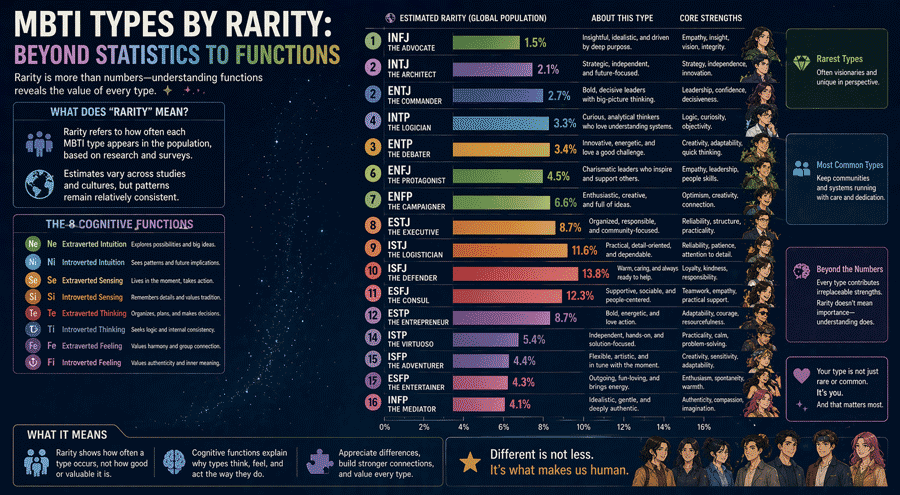
Understanding your personality is not about finding a rare label; it is about unlocking self-awareness. When searching for mbti types by rarity, many readers hope to find validation in being unique. However, the true value of the Myers-Briggs Type Indicator lies not in statistical scarcity but in cognitive function dynamics. A rare type is not inherently better, nor is a common type inferior. The goal is accurate self-understanding to improve decision-making, relationships, and growth. This article moves beyond surface-level statistics to explore the mechanisms that actually define your psychological preferences.
The MBTI framework helps individuals identify how they perceive the world and make decisions. It is useful for career planning, team dynamics, and personal development. Yet, relying solely on popularity charts can lead to mistyping. To apply the concept of mbti types by rarity effectively, you must return to the underlying cognitive functions. This conclusion-first approach ensures you focus on utility rather than identity politics. Whether you are an INFJ often cited as rare or an ESTJ known for prevalence, your growth path depends on function development, not population percentages.
The Framework: Jungian Roots and Cognitive Mechanisms
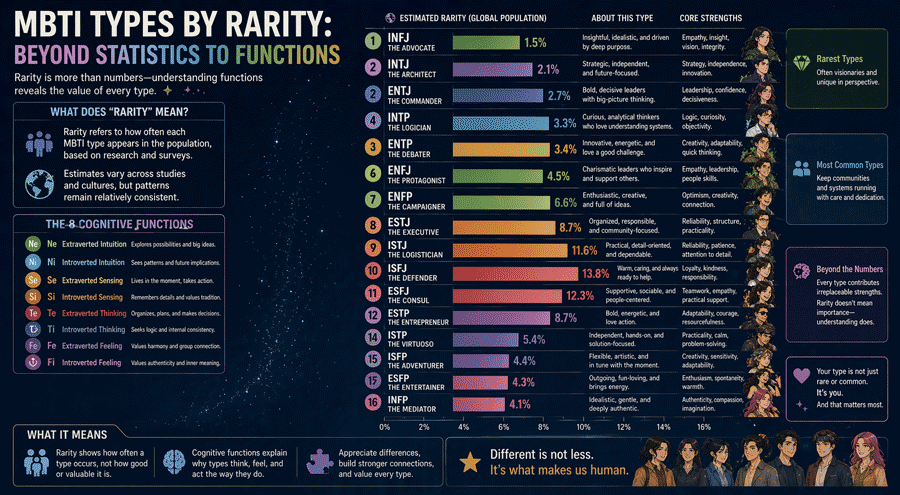
To understand why rarity statistics are often misleading, we must examine the Jungian roots of the MBTI. Carl Jung proposed that human behavior results from distinct psychological types. The MBTI expanded this into four dichotomies: Extraversion vs. Introversion, Sensing vs. Intuition, Thinking vs. Feeling, and Judging vs. Perceiving. These combine to form the 16 personality types. However, the letters are merely indicators of a deeper stack of cognitive functions.
Each type operates using a hierarchy of four functions: dominant, auxiliary, tertiary, and inferior. For example, an INTJ leads with Introverted Intuition (Ni) supported by Extraverted Thinking (Te). An INTP, while sharing three letters, leads with Introverted Thinking (Ti) supported by Extraverted Intuition (Ne). This distinction is crucial. Two people may test as similar types but operate with entirely different mental processes. This is why letter-based typing alone often causes mistypes. A person might identify as intuitive because they enjoy abstract ideas, but if their decision-making is driven by internal logic rather than external efficiency, their function stack differs.
Validating your type requires more than a quiz. It demands self-observation of decision patterns, stress reactions, and motivation. Ask yourself: Where do you gain energy? How do you process information? What happens when you are under extreme pressure? Long-term feedback from others is also vital. Friends may notice patterns you miss, such as a tendency to overlook details or a habit of prioritizing harmony over truth. If needed, consider famous public figures only as illustrative examples. For instance, Albert Einstein is widely believed to be an INTP, demonstrating deep theoretical focus, while Oprah Winfrey is often typed as an ENFJ, showcasing empathetic leadership. These examples highlight function expression, not definitive labels.
The relationship between the 16 types and rarity is often based on outdated or non-representative samples. Some types appear rare because certain traits are less socially encouraged, not because they are biologically scarce. For example, Feeling types in corporate leadership might be underreported due to cultural biases favoring Thinking styles. Therefore, treating mbti types by rarity as a fixed hierarchy undermines the tool's purpose. The mechanism matters more than the frequency.
Application Guidance: Practical Frameworks for Daily Life
Knowing your type is useless without application. Here are two practical frameworks to utilize your personality insights effectively. These frameworks focus on cognitive function development and relationship communication, providing actionable steps for readers seeking depth beyond stereotypes.
Framework 1: Cognitive Function Development
When it applies: This framework is best for individuals seeking personal growth, career alignment, or stress management. It relates to all types but requires identifying your dominant and inferior functions.
Type Dynamics: Every type has a strength (dominant) and a weakness (inferior). For example, an ESFJ leads with Extraverted Feeling (Fe), making them naturally attuned to group harmony. Their inferior function is Introverted Thinking (Ti), which may manifest as difficulty analyzing logical inconsistencies under stress.
Practical Action Steps:
- Identify the Dominant Function: Reflect on what feels effortless. If organizing data feels natural, you might lead with Thinking. If understanding people's emotions is automatic, Feeling may be dominant.
- Stretch the Auxiliary: If you are an introvert, practice engaging with the external world using your auxiliary function. An INFP (Fi-Ne) should practice brainstorming ideas outwardly (Ne) rather than keeping them internal.
- Respect the Inferior: Do not try to make your inferior function your primary mode. Instead, engage it in low-stakes environments. An ISTP (Ti-Se) can explore artistic expression (inferior Fe) without pressure to lead emotionally.
Benefits and Limitations: This approach builds resilience and reduces burnout. However, it requires patience. Function development takes years, not weeks. Readers can judge fit by noting if specific exercises reduce anxiety or increase clarity.
Framework 2: Relationship and Communication Guidance
When it applies: Use this for conflict resolution, team collaboration, or intimate partnerships. It relates to how different types process information and express value.
Type Dynamics: Communication breakdowns often occur between Sensing and Intuitive types or Thinking and Feeling types. A Sensor may view an Intuitive's ideas as impractical, while the Intuitive views the Sensor as rigid. A Thinker may see a Feeler's concerns as illogical, while the Feeler sees the Thinker as cold.
Practical Action Steps:
- Translate Preferences: When speaking to a Thinking type, structure your argument logically. When speaking to a Feeling type, acknowledge the human impact first.
- Validate Differences: Explicitly state that different approaches are valid. Say, "I see you focus on details, while I focus on the big picture. Both are needed."
- Adjust Feedback Styles: Some types prefer direct critique (Thinkers), while others need sandwich feedback (Feelers). Adapt your delivery to the receiver's preference.
Benefits and Limitations: This reduces interpersonal friction and builds trust. The limitation is that it requires effort from both parties. Readers can judge fit by observing if conflicts resolve faster when these strategies are employed.
Growth Section: Universal Principles for Personality Development
Growth in the context of MBTI is not about changing your type; it is about expanding your capacity within it. There are universal principles that apply regardless of your specific four letters. These principles ensure that you use the tool for empowerment rather than limitation.
Identify the Dominant Function First: Your dominant function is your core lens. Protecting time for this function to operate is essential for mental health. If you are an intuitive type forced into repetitive sensory work without breaks, you will drain quickly. Recognize what recharges you.
Distinguish Preference from Skill: Just because you prefer Thinking does not mean you are good at logic, nor does preferring Feeling mean you are empathetic. Skills are developed; preferences are innate. Do not use type as an excuse for lacking skills. An introvert can learn public speaking; a feeler can learn data analysis.
Develop the Inferior Function Gradually: The inferior function is a source of stress but also growth. In mid-life, many individuals find balance by integrating this function. For example, a dominant Thinker might find joy in volunteering or mentoring, engaging their Feeling side without compromising their core identity.
Explain Loop and Grip Patterns: Under stress, types may skip their auxiliary function and enter a "loop." An INTP might loop between Ti and Ne, becoming paralyzed by analysis and possibilities without taking action. In a "grip," the inferior function takes over. An ENTJ (inferior Fi) might become unusually emotional or withdrawn when overwhelmed. Recognizing these patterns allows you to step back and restore balance.
Growth Means Flexibility, Not Identity Attachment: The biggest pitfall is treating your type as a rigid identity. "I am an ENFP, so I cannot do details" is a limiting belief. Growth means becoming flexible enough to access non-preferred functions when the situation demands it. Your type is a starting point, not an endpoint.
Mistakes and Pitfalls: What Not to Do
To maintain credibility and utility, avoid these common errors when engaging with personality theory. Each point includes a better alternative mindset to guide your journey.
- Don't treat type as destiny. Explanation: Your type describes preferences, not capabilities. Alternative: View type as a map of your natural terrain, not a fence around your potential.
- Don't ignore context. Explanation: Behavior changes based on environment. A quiet person at work may be loud at home. Alternative: Observe patterns across different contexts before typing.
- Don't rely solely on online tests. Explanation: Tests measure self-perception, which can be biased. Alternative: Use tests as a starting hypothesis, then validate through study and reflection.
- Don't stereotype others. Explanation: Assuming you know someone's mind based on their type is disrespectful. Alternative: Use type to generate questions, not answers, about others.
- Don't use type to excuse bad behavior. Explanation: "I'm a Perceiver, so I'm late" is irresponsible. Alternative: Acknowledge preferences but take responsibility for impacts.
- Don't obsess over rarity. Explanation: Being rare does not make you special or misunderstood. Alternative: Focus on how your unique combination of functions serves your goals.
- Don't mix systems carelessly. Explanation: MBTI, Enneagram, and Big Five are different models. Alternative: Study each system on its own terms before integrating them.
- Don't stop learning. Explanation: Personality theory evolves. Sticking to one book limits understanding. Alternative: Keep exploring new research and interpretations to refine your view.
Ongoing Learning: Resources and Credibility
The field of personality psychology is vast. To avoid low-quality summaries, readers should seek credible organizations and higher-quality resources. New research continues to refine how we understand psychological types. Engaging with debates and newer interpretations keeps your knowledge current.
Encourage readers to follow resources like the Myers & Briggs Foundation, which provides official information on the instrument. The Center for Applications of Psychological Type (CAPT) offers research-based insights. Jungian educational resources can provide depth on the theoretical roots. When judging information quality, look for authors who cite sources, acknowledge limitations, and avoid absolute claims. Be wary of content that promises instant typing or guarantees compatibility based solely on letters. Reliable information emphasizes nuance and individual variation.
Identifying reliable information involves checking the author's credentials and the date of publication. Older materials may lack modern psychological context. Newer interpretations often integrate neuroscience or behavioral economics. By staying informed, you ensure that your understanding of mbti types by rarity remains grounded in reality rather than internet myths.
Frequently Asked Questions
1. Where should a beginner start with MBTI?
Start by reading about the four dichotomies, then move to cognitive functions. Take a reputable test as a reference point, but do not treat the result as final. Observe your own behavior for a few weeks.
2. How can I confirm my type without tests?
Study the cognitive function stacks. Compare your stress reactions and decision-making processes to the descriptions. Ask trusted friends for feedback on your blind spots and strengths.
3. Does MBTI help with relationship communication?
Yes, by highlighting differences in information processing. It helps partners understand why one needs space while the other needs talk, reducing personalization of conflicts.
4. How do I learn cognitive functions efficiently?
Focus on one function pair at a time. For example, study Te vs. Ti before moving to Fe vs. Fi. Use real-life examples to anchor the abstract concepts.
5. Can my personality type change over time?
Your core preferences generally remain stable, but your expression of them evolves. As you develop functions, you may appear different to others, but the underlying structure remains consistent.