
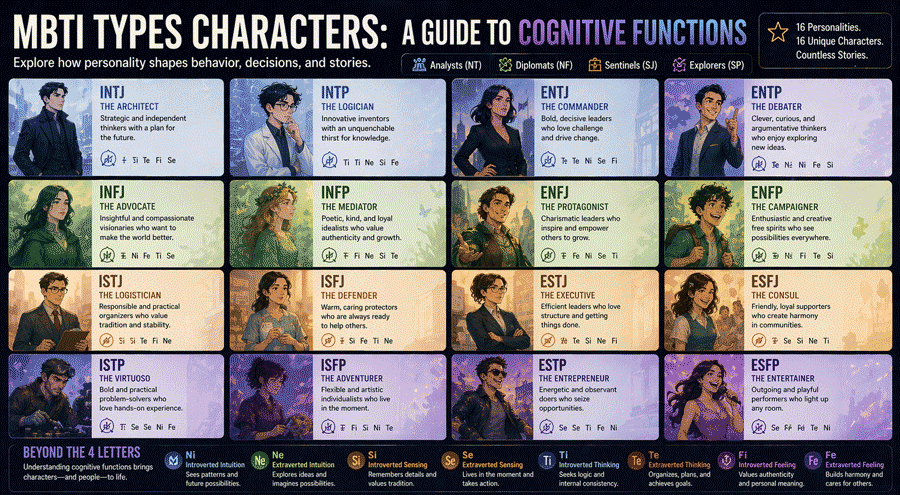
When exploring personality psychology, many users search for mbti types characters to find relatable examples or definitive traits. However, relying solely on surface-level characteristics often leads to stereotypes. The Myers-Briggs Type Indicator (MBTI) is a tool for understanding preferences, not a label that defines the whole person. To truly understand yourself, you must look beyond the four letters and examine the underlying cognitive functions. This article provides a conclusion-first approach: accurate typing requires analyzing how you process information and make decisions, not just matching behaviors to a list.
The purpose of this guide is to move you from casual curiosity to deep self-awareness. Whether you are interested in career fit, relationship dynamics, or personal growth, the key lies in understanding the mechanism behind the type. We will explore the Jungian roots of the system, the dangers of mistyping, and practical frameworks for development. By the end, you will have a robust method for validating your type and using it as a starting point for growth rather than an endpoint for identity.
The Framework: Beyond the Four Letters
To understand mbti types characters accurately, one must first understand the theoretical engine driving the system. The MBTI is based on Carl Jung’s theory of psychological types, which posits that much of what appears to be random variation in human behavior is actually quite orderly and consistent, being due to basic differences in the ways individuals prefer to use their perception and judgment.
Jungian Roots and Dichotomies
The four dichotomies—Extraversion vs. Introversion, Sensing vs. Intuition, Thinking vs. Feeling, and Judging vs. Perceiving—are the most visible part of the MBTI. However, these letters are merely indicators of deeper cognitive processes. Extraversion and Introversion describe where you direct your energy. Sensing and Intuition describe how you gather information. Thinking and Feeling describe how you make decisions. Judging and Perceiving describe how you orient yourself to the external world.
While useful, these dichotomies can be misleading if taken in isolation. For example, two people may both test as “Thinking” types, but one may prioritize logical consistency internally (Ti) while the other prioritizes objective criteria externally (Te). This distinction is invisible in the four-letter code but crucial for understanding behavior. This is why searching for mbti types characters based only on letters often results in confusion.
The Cognitive Function Stack
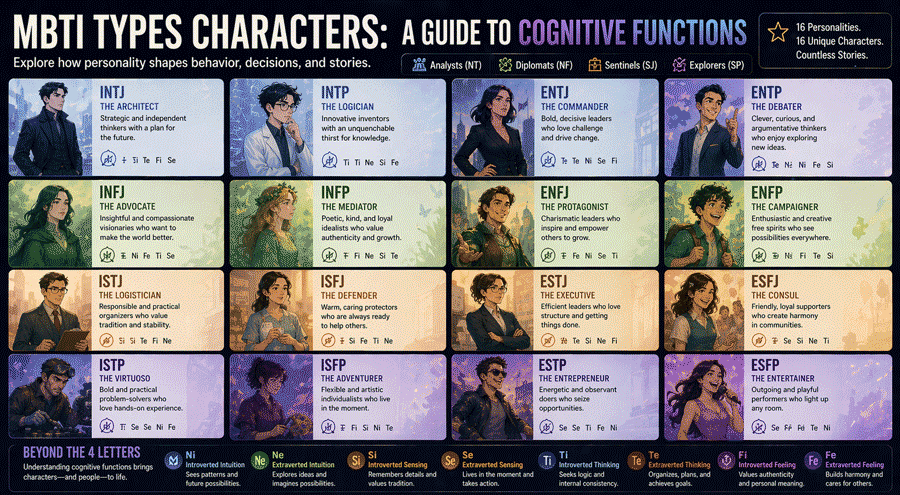
The core of accurate typing lies in the cognitive function stack. Every type has four primary functions arranged in a specific order: Dominant, Auxiliary, Tertiary, and Inferior. The Dominant function is the hero of the psyche, the lens through which you primarily view the world. The Auxiliary function supports the dominant, providing balance. The Tertiary function is less developed but offers relief, while the Inferior function is the unconscious weak spot that often emerges under stress.
For instance, an INTJ leads with Introverted Intuition (Ni), supported by Extraverted Thinking (Te). An INTP, however, leads with Introverted Thinking (Ti), supported by Extraverted Intuition (Ne). Although they share three letters, their core operating systems are fundamentally different. Understanding this stack is essential when analyzing mbti types characters because it explains why two types with similar letters can behave differently in critical situations.
Why Letter-Based Typing Causes Mistypes
Many online tests rely on self-reported behaviors rather than cognitive processes. If you answer questions based on how you wish to be or how you have adapted to your environment, the result will be inaccurate. For example, an Introvert who works in sales may develop strong extraverted skills, leading a test to type them as an Extravert. Similarly, a Feeling type who works in finance may prioritize logic, appearing as a Thinking type.
Mistypes often occur because people confuse competence with preference. You may be skilled at organizing data (Te), but if it drains you rather than energizes you, it is likely not your dominant preference. To avoid this, you must observe your natural inclinations when you are relaxed and unobserved. This depth is rarely captured when people simply look up mbti types characters online without studying the functions.
Validating Your Type Through Observation
Confirming your type is an iterative process of self-observation. It requires honesty about your motivations, stress reactions, and energy sources. Tests can provide a hypothesis, but validation comes from life experience.
Decision Patterns and Motivation
Pay attention to what drives your decisions. Do you prioritize harmony and personal values, or logical consistency and objective efficiency? When making a choice, is your first instinct to consider how it affects people (Feeling) or whether it makes sense structurally (Thinking)? Furthermore, observe what motivates you. Are you driven by the possibility of future patterns (Intuition) or the reality of present facts (Sensing)?
These internal processes are more reliable than external behaviors. A person might appear organized (Judging) but feel internally spontaneous and open-ended (Perceiving). Validating your type requires looking inward at these cognitive habits rather than outward at social masks.
Stress Reactions and the Inferior Function
One of the most reliable ways to identify your type is to observe your behavior under extreme stress. This is often when the Inferior function “grips” the personality. For example, a typical thinking-dominant type might become overly emotional or hypersensitive to criticism when overwhelmed. A judging-dominant type might become impulsive and reckless. Recognizing these stress patterns can help distinguish between types that look similar on the surface.
Using Public Figures Cautiously
It is common to look at famous individuals to understand mbti types characters. However, celebrity typings are often speculative. For instance, Elon Musk is widely believed to be an INTJ or ENTJ, but without his direct participation, this remains an observation of public persona, not internal cognition. Use public figures as illustrative examples of function dynamics, not as definitive proof of typing. Focus on how they solve problems rather than just their career title.
Practical Application Frameworks
Understanding your type is only useful if applied. Below are two frameworks to help you utilize this knowledge for development and interaction.
Framework 1: Cognitive Function Development
This framework focuses on strengthening your function stack over time. It applies to anyone seeking personal growth and is particularly relevant for understanding how maturity changes type expression.
When it applies: Use this when you feel stuck in repetitive patterns or want to improve weak areas. It relates to all types but specifically targets the Tertiary and Inferior functions.
Practical Action Steps: First, identify your Dominant function and ensure it is being utilized in your daily life. If you are an Intuitive dominant, ensure you have time for brainstorming and conceptual work. Second, consciously engage your Auxiliary function to balance the dominant. If you are a Perceiver, practice some structured planning to support your exploration. Third, approach your Inferior function with kindness. Do not try to force it to be dominant. Instead, engage it in low-stakes environments. For example, a Thinking dominant can practice expressing emotions in safe relationships without expecting logical solutions.
Benefits and Limitations: The benefit is a more balanced personality and reduced stress. The limitation is that developing inferior functions takes years. You will never be as natural at your inferior function as you are at your dominant. Accepting this limitation is part of the growth.
How to Judge Fit: If practicing these steps makes you feel more energized and less defensive, the framework fits. If it feels like forcing yourself to be someone else, you may have mistyped.
Framework 2: Communication and Relationship Guidance
This framework uses type knowledge to improve interactions with others. It is essential for teams, partners, and families.
When it applies: Use this during conflicts or when collaboration feels difficult. It relates to the interaction between different function stacks, such as how a Thinking type communicates with a Feeling type.
Practical Action Steps: Identify the other person’s likely preference. If they are Sensing, provide concrete details and real-world examples rather than abstract theories. If they are Feeling, acknowledge their values and the human impact before discussing logic. Adjust your delivery style without changing your core message. For instance, an INTJ explaining a plan to an ESFJ should start with how the plan helps the team (Fe) before detailing the system efficiency (Te).
Benefits and Limitations: The benefit is reduced friction and increased empathy. The limitation is that you cannot type others definitively without their input. Use this as a hypothesis to test communication styles, not as a label to dismiss someone’s behavior.
How to Judge Fit: If conflicts decrease and mutual understanding increases, the approach is working. If you find yourself stereotyping others (“They are just an ENFP, they are flaky”), you are misusing the framework.
Principles of Personality Growth
Growth in the context of MBTI is not about changing your type; it is about expanding your flexibility within your type. There are universal principles that apply to all sixteen types.
Identify the Dominant Function First
Growth begins with leveraging your strengths. You cannot build a stable structure on a weak foundation. Ensure your dominant function is healthy and well-exercised before worrying about developing weaker areas. A stressed dominant function will sabotage any attempts to grow the inferior function.
Distinguish Preference from Skill
You can learn skills outside your preference. An Introvert can learn public speaking; a Feeling type can learn accounting. Do not confuse the ability to do something with the preference for doing it. Growth involves acquiring necessary skills while respecting your energy limits.
Develop the Inferior Function Gradually
The inferior function is a source of growth but also vulnerability. Engage it in small doses. If you are a Judging type, allow for spontaneous weekends occasionally. If you are a Perceiving type, try setting one firm deadline. Pushing too hard too fast leads to burnout.
Understand Loop and Grip Patterns
A “loop” occurs when you bypass your auxiliary function and oscillate between your dominant and tertiary. This often leads to unbalanced behavior. A “grip” occurs when stress overwhelms the dominant function, and the inferior function takes over negatively. Recognizing these states helps you return to balance. For example, if an INFJ becomes overly critical and logical (Ti loop), they need to re-engage their auxiliary Feeling function to reconnect with values.
Growth Means Flexibility, Not Identity Attachment
Do not use your type as an excuse (“I can’t do that, I’m an INTP”). Type describes preferences, not capabilities. True growth means becoming more adaptable while remaining true to your core energy sources. Avoid attaching your identity so rigidly to the four letters that you resist necessary change.
Common Mistakes and Pitfalls
To ensure you are using the MBTI effectively, avoid these eight common pitfalls. Each point includes a better alternative mindset.
1. Don’t treat the four letters as a horoscope.
Explanation: Treating type descriptions as fate removes agency.
Alternative: View type as a map of preferences that you can navigate consciously.
2. Don’t assume type determines career success.
Explanation: Any type can succeed in any field with the right strategies.
Alternative: Use type to understand your work style and energy needs, not to limit job choices.
3. Don’t use type to justify bad behavior.
Explanation: Saying “I’m blunt because I’m a Thinker” ignores emotional impact.
Alternative: Acknowledge your preference but take responsibility for how you communicate.
4. Don’t rely solely on online tests for confirmation.
Explanation: Tests measure self-perception, which can be biased.
Alternative: Use tests as a starting point, then validate through study and observation.
5. Don’t stereotype others based on their type.
Explanation: Assuming you know someone’s motives based on their letters reduces empathy.
Alternative: Use type to generate hypotheses about their needs, then ask them directly.
6. Don’t ignore the context of behavior.
Explanation: People adapt to environments; behavior changes based on role.
Alternative: Observe people in relaxed, low-stakes environments to see their true preferences.
7. Don’t focus only on the positive traits of your type.
Explanation: Every type has blind spots and weaknesses.
Alternative: Study the unhealthy expressions of your type to recognize them in yourself.
8. Don’t expect type to solve all relationship issues.
Explanation: Compatibility is complex and involves values, not just cognition.
Alternative: Use type to improve communication, but address core value conflicts directly.
Ongoing Learning and Resources
The field of personality psychology is evolving. To maintain accuracy, keep following new research and higher-quality resources. Avoid low-quality summaries that reduce complex theories to memes.
Credible organizations include the Myers & Briggs Foundation and the Center for Applications of Psychological Type (CAPT). These bodies maintain the integrity of the instrument and provide educational resources. Jungian educational resources also offer depth on the cognitive functions that underpin the MBTI.
Engage with debates and newer interpretations. Understand that the MBTI is not scientifically uncontested; it is a tool for understanding preferences, not a psychometric measure of intelligence or ability. Identify reliable information by checking if the source emphasizes cognitive functions over stereotypes. Avoid content that claims certain types are “better” or “more successful.” True learning involves humility and continuous self-reflection.
Frequently Asked Questions
1. Where should a beginner start with MBTI?
Start by learning the four dichotomies, then move quickly to cognitive functions. Read official manuals or credible guides rather than social media posts. Take a test to get a baseline, but do not treat the result as final.
2. How can I confirm my type without tests?
Study the cognitive function stacks. Observe your energy levels after different activities. Ask trusted friends how they perceive your decision-making processes. Look for patterns in your stress reactions.
3. Does MBTI help with relationship communication?
Yes, by highlighting differences in information processing. It helps partners understand that a difference in style is not a difference in care. However, it does not replace active listening and conflict resolution skills.
4. How do I learn cognitive functions efficiently?
Focus on one axis at a time (e.g., Sensing vs. Intuition). Compare types that share functions but differ in order. Keep a journal of your daily decisions to track which functions you are using.
5. Can my personality type change over time?
Your core preferences generally remain stable throughout adulthood. However, your expression of them changes as you develop skills and mature. You may learn to use non-preferred functions more effectively, but your underlying energy orientation typically stays the same.
Conclusion
Understanding mbti types characters is a journey from surface stereotypes to deep cognitive awareness. By focusing on functions rather than letters, validating through observation, and applying practical frameworks, you can use the MBTI as a powerful tool for growth. Remember that type is a starting point. The goal is not to fit neatly into a box, but to understand the box well enough to know when to step outside of it. Continue learning, stay objective, and use these insights to build a more flexible and authentic life.