
Ultimate Analysis of Donald Trump's MBTI Type
What is Donald Trump's MBTI type? This article examines his personality traits, behavior patterns, historical stages, psychological analysis, and data comparisons to explore his possible personality type, and how it has shaped his political and business journey.
1. Introduction: Why Discuss Donald Trump's MBTI Type
The question "What is Donald Trump's MBTI type" is not only a favorite among psychology enthusiasts but also a key to understanding his political and business behavior. Trump's strong personality and high-profile actions have won him passionate supporters and fierce critics alike. MBTI analysis offers a structured way to break down the psychological framework behind such a complex character.
2. MBTI Theory and Analytical Method
Before exploring what is Donald Trump's MBTI type, it’s essential to understand the MBTI (Myers-Briggs Type Indicator) framework:
Extraversion (E) / Introversion (I) Sensing (S) / Intuition (N) Thinking (T) / Feeling (F) Judging (J) / Perceiving (P)
Public figures’ MBTI types are usually deduced through behavioral observation, not formal testing. This means any conclusion about what is Donald Trump's MBTI type will carry an element of speculation.
3. Overview of Trump’s Personality Traits
Highly extraverted: Thrives on public stages with high energy. Direct communication: Sharp, unfiltered speech, unafraid of controversy. Confidence and dominance: Plays the decision-maker role in both business and politics. Risk-taking and opportunity-driven: Bold decisions in business and political arenas. Personal brand focus: Turned “Trump” into a globally recognized brand.
These traits provide key clues in determining what is Donald Trump's MBTI type.
4. Step-by-Step Personality Dimension Analysis
1. Extraversion (E) or Introversion (I)?
Trump is a textbook Extravert — energized by interaction and visibility.
2. Sensing (S) or Intuition (N)?
He focuses on tangible results and reality (S) but also shows strategic foresight (N).
3. Thinking (T) or Feeling (F)?
Decision-making is based on logic and results, clearly T-oriented.
4. Judging (J) or Perceiving (P)?
Strong planner with high control tendencies — more J than P.
5. Most Likely MBTI Type Hypotheses
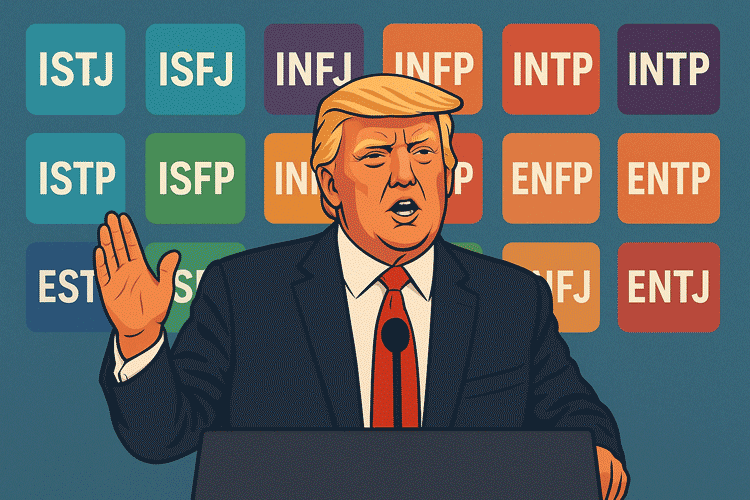
ENTJ (The Commander): Strategic leader, decisive, goal-driven. ESTP (The Entrepreneur): Action-oriented, adaptable, seizes opportunities.
Most analysts lean toward ENTJ, though ESTP remains a reasonable alternative.
6. Psychological and Expert Opinions
Political psychology studies show ENTJ and ESTP types are common among high-level leaders. Some psychologists believe Trump fits ENTJ because he’s not just an executor but also a strategic planner.
7. Impact of MBTI Type on Trump’s Politics and Business
If ENTJ:
Highly goal-driven Decisive and assertive Strategic brand building
If ESTP:
Skilled at spotting opportunities Flexible and adaptable Mastery of media engagement
8. Comparative Cases
ENTJ examples: Winston Churchill, Steve Jobs
ESTP examples: Theodore Roosevelt, Richard Branson
 9. Historical Stage Analysis
1. Business Early Years (1980–2000)
Bold investments and risk-taking — leaning ESTP.
2. Reality TV Era (2004–2015)
In The Apprentice, showed command and decisiveness — leaning ENTJ.
3. Presidency (2016–2020)
Strategic moves in international affairs — strong ENTJ traits.
4. Post-Presidency (2021–Present)
Maintains high media presence, adjusts political stance — ESTP flexibility.
10. US Presidents MBTI Comparison Table
| President | Hypothesized MBTI | Core Traits |
|---|---|---|
| Donald Trump | ENTJ / ESTP | Decisive, direct, dominant |
| Barack Obama | ENFJ | Inspiring, long-term vision |
| Joe Biden | ENFP | Friendly, adaptable |
| Ronald Reagan | ESFJ | Warm, people-oriented |
11. Three Common Misconceptions About Donald Trump’s MBTI Type
MBTI type never changes
In reality, outward expressions may shift with roles and environments.ESTP and ENTJ are completely different
They overlap in extraversion and action-orientation.Only official tests can determine type
Public figures are often assessed through observed behavior.
12. Data-Driven Analysis: Language and Behavior Patterns
Analysis of Trump’s speeches and social media shows:
Frequent use of action verbs (e.g., win, build, make) High rate of goal-oriented vocabulary High proportion of emotionally charged, energetic words
These linguistic traits align more with ENTJ and ESTP patterns.
13. Conclusion and Reflection
Considering behavioral evidence, historical context, expert insights, and data analysis, the most likely answer to what is Donald Trump's MBTI type is ENTJ, with ESTP as a secondary possibility. This personality profile explains his dominant leadership style and influence in both politics and business.
What do you think is Donald Trump’s MBTI type? Share your thoughts and join the discussion.
A1: Most likely ENTJ, with ESTP as the second possibility.
Q2: Why is there disagreement?A2: He exhibits both strategic planning traits (ENTJ) and adaptability traits (ESTP).
How did his MBTI type affect his presidency?As an ENTJ, it explains his decisive decisions and strategic moves; as an ESTP, it explains his flexibility and opportunistic approach.