
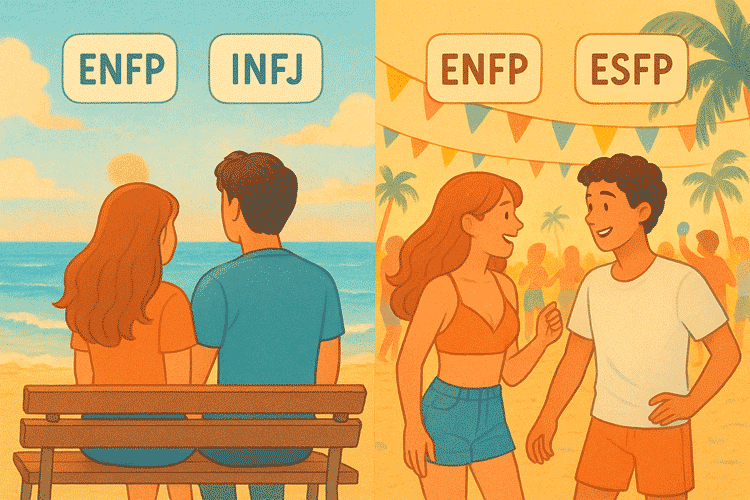
The INFJ personality is one of the 16 MBTI types driven primarily by intuition and internal values, and many people search for INFJ after taking an MBTI test because they feel deeply understood by the description while also struggling with long-term inner conflict; the image shows a figure symbolizing the INFJ’s rich inner world and ideal-driven nature, helping readers visually understand the personality theme.
Why Do So Many People Search for the INFJ Personality?
Most people who search for INFJ are not simply curious—they are looking for answers to personal confusion they have carried for a long time.
Common questions include:
Why do I think so deeply but struggle to express myself?
Why am I highly sensitive to others’ emotions yet neglect my own needs?
Why do I want to stay true to myself but still find it hard to say no?
These experiences do not mean something is wrong with you. They are common outcomes of how the INFJ personality processes the world. Understanding INFJ is not about memorizing traits, but about understanding its cognitive pattern.
What Does the INFJ Personality Actually Describe?
INFJ is not simply “introverted, kind, and thoughtful.” It describes a personality type that operates through deep internal intuition combined with outward emotional awareness.
From an MBTI perspective, INFJ is characterized by:
Introverted Intuition (Ni): Focus on meaning, patterns, and long-term direction
Extraverted Feeling (Fe): Strong awareness of others’ emotions and social harmony
Introverted Thinking (Ti): Internal logic-checking and self-analysis
Extraverted Sensing (Se): Relatively higher energy cost when dealing with immediate sensory input
As a result, INFJs often experience tension between a rich inner world and restrained external expression. This is not a flaw—it is a natural outcome of their cognitive preferences.
How Can You Tell If You Are Truly an INFJ?
Many people identify as INFJ after a single test, but a more accurate approach is to observe long-term behavior patterns.
You can use the following steps:
Step 1: Review Multiple MBTI Results
If your results consistently lean toward INFJ over time, rather than appearing once, the likelihood is higher.
Step 2: Observe How You Make Decisions
INFJs typically make decisions based on internal values and long-term insight rather than momentary emotion.
Step 3: Distinguish INFJ from INFP
INFJs tend to form an internal direction before acting, while INFPs prioritize staying true to immediate feelings. If structure and long-term meaning matter more to you, INFJ may be a better fit.
Typical Strengths and Common Struggles of INFJs
Strengths
Strong insight into people and underlying motivations
High empathy and emotional awareness
Consistency with personal values and ideals
Common Struggles
Chronic overthinking and internal exhaustion
Weak emotional boundaries
Feeling disconnected from fast-paced or surface-level environments
These strengths and struggles often coexist, which is why INFJs frequently feel internally conflicted.
How INFJs Can Thrive in Real Life
For INFJs, growth is not about becoming more outgoing—it is about protecting and managing their internal energy.
At work:
INFJs thrive in roles involving strategy, insight, and long-term planning
They struggle in environments with constant interruptions and emotional overload
In relationships:
Learning the difference between understanding others and taking responsibility for them is crucial
Healthy boundaries matter more than constant accommodation
In personal growth:
Inner conflict is a signal, not a failure
INFJs benefit from environments that respect depth and reflection
Common Misconceptions About INFJs
INFJ does not mean self-sacrificing: Empathy is not obligation
INFJs are not emotionally unstable: They often regulate emotions carefully
INFJs are not weak: They simply avoid unnecessary conflict
Clarifying these misconceptions helps INFJs develop a more stable self-understanding.
Key Takeaways About the INFJ Personality
INFJ is driven by intuition and internal values
Inner conflict comes from cognitive style, not personal failure
Establishing boundaries is essential for INFJ growth
The right environment amplifies INFJ strengths
Frequently Asked Questions (FAQ)
Is the INFJ personality accurate?
INFJ descriptions often resonate strongly, but accuracy depends on long-term behavior rather than a single test.
Can INFJ personality change over time?
Core personality preferences remain stable, but expression matures with experience.
Are INFJs rare?
INFJs are often described as rare, but many people identify with INFJ traits due to the depth of the descriptions.
What careers suit INFJs best?
INFJs excel in roles that require insight, planning, and values-driven decision-making.
Why do INFJs experience so much inner conflict?
Because internal values often clash with external expectations, and INFJs tend to process these conflicts inwardly.