
I. Why Has “ADHD × MBTI” Become a High-Volume Search Topic?
In recent years, search queries such as:
- adhd mbti
- which mbti types are most like adhd
- enfp adhd
- do I have adhd or is it just my personality
have increased dramatically.
This trend is driven by two parallel developments:
On one hand, adult ADHD awareness has rapidly expanded.
On the other hand, MBTI has become one of the most popular personality frameworks on the internet.
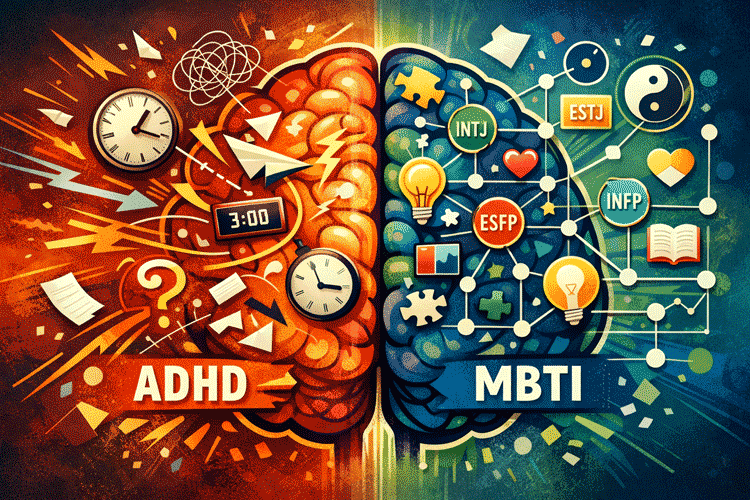
When people notice that they:
- get distracted easily
- struggle with chronic procrastination
- experience emotional volatility
- rely heavily on interest to function
they naturally begin to wonder:
“Is this ADHD, or is it just my MBTI personality?”
II. Core Conclusion: ADHD Is Not an MBTI Type, but It Amplifies Certain MBTI Behaviors
This is the most important foundation for understanding ADHD × MBTI:
ADHD is a neurodevelopmental condition.
MBTI is a personality preference model.
They do not exist on the same dimension.
However, when ADHD overlaps with certain MBTI types,
their outward behaviors can look strikingly similar.
III. Fundamental Differences Between ADHD and MBTI (Critical Distinction)
| Dimension | ADHD | MBTI |
|---|---|---|
| Nature | Neurodevelopmental difference | Personality preference model |
| Medical diagnosis | ✅ Yes | ❌ No |
| Largely innate | ✅ Yes | ⚠️ Preference-based |
| Can be changed by willpower | ❌ Rarely | ✅ To some extent |
| Directly affects executive function | ✅ Core issue | ❌ Not directly |
In short:
ADHD affects whether you can consistently use your abilities.
MBTI affects how you prefer to think and act.
IV. Why Intuitive (N) MBTI Types Are Often Mistaken for ADHD
In ADHD-related searches, certain MBTI types appear far more often than others:
- ENFP
- ENTP
- INFP
- INTP
Their shared trait is clear:
? Dominant Intuition (N)
Typical Traits of Intuitive Types
- Divergent thinking
- Rapid idea generation
- Resistance to repetitive processes
- Strong interest-based motivation
On the behavioral level, these traits closely resemble ADHD attention patterns,
but the underlying mechanisms are very different.
V. MBTI Types Most Commonly Confused with ADHD (Deep Analysis)
1️⃣ ENFP × ADHD: The Most Searched Combination
ENFP is often described as “the MBTI type most like ADHD.”
Overlapping traits:
- Explosive productivity when interested
- Severe procrastination when bored
- Emotion-driven focus
- Many ideas, weak follow-through
Key distinction:
- Pure ENFPs can sustain focus in areas they love
- ADHD ENFPs may struggle even with passion projects
? ENFP is not ADHD, but ADHD intensifies ENFP instability
2️⃣ ENTP × ADHD: Idea Generator or Hyperactive Mind?
Typical ENTP traits:
- Fast, nonlinear speech and thinking
- Love of debate and challenge
- Resistance to rigid rules
Overlap with ADHD:
- Interrupting others
- Starting many projects
- Rapid boredom
The key difference lies in executive stability:
- ENTP: structured internal logic
- ADHD: inconsistent execution systems
3️⃣ INFP × ADHD: A Frequently Overlooked Combination
INFPs are often seen as “too quiet” to have ADHD, but:
- Their internal world is extremely active
- Emotional exhaustion is common
- Task initiation is often very difficult
? This makes INFP a high-risk profile for internalized ADHD.
4️⃣ INTP × ADHD: Cognitive Overload vs Action Paralysis
Common INTP + ADHD patterns:
- Deep analytical thinking
- Slow or stalled execution
- Perfectionism-driven procrastination
External perception:
“You’re just not paying attention.”
Reality:
The attention is internal—execution is offline.
VI. How to Tell: ADHD or “ADHD-Like” MBTI Traits?
Use the following five dimensions to self-evaluate:
✅ 1. Is your focus interest-dependent?
- Only focused when interested → MBTI
- Struggle even when interested → ADHD
✅ 2. Did these issues start in childhood?
- Yes → Key ADHD indicator
- No → More likely personality or environment
✅ 3. Do you experience severe time blindness?
- Chronic underestimation of time
- Last-minute “activation” before deadlines
? Strong ADHD signal
✅ 4. Do you rely heavily on external pressure to start?
- Yes → Executive function impairment
✅ 5. Does changing environments significantly help?
- Yes → MBTI-driven challenges
- No → ADHD more likely
VII. The Real Value of ADHD × MBTI: Strategy, Not Labels
One crucial insight is often overlooked:
MBTI cannot diagnose ADHD,
but it can optimize coping strategies for ADHD brains.
Example: ADHD × ENFP
- Avoid: long linear plans
- Use: short feedback loops + visual reminders
Example: ADHD × INTP
- Avoid: vague goals
- Use: clear structures + behavioral triggers
FAQ: ADHD × MBTI (Based on Real Search Intent)
1. Can MBTI determine whether I have ADHD?
No. MBTI is a personality framework, not a medical diagnostic tool. ADHD can only be diagnosed by qualified professionals.
2. Why are ENFPs so often associated with ADHD?
Because ENFP traits like idea hopping, interest-based motivation, and resistance to routine closely resemble ADHD behaviors at the surface level.
3. Can introverts like INFP or INTP have ADHD?
Yes. ADHD does not require hyperactivity. Many introverted ADHD individuals experience internal restlessness rather than outward impulsivity.
4. If I relate to ADHD traits, does that mean I have ADHD?
Not necessarily. Personality traits, stress, environment, and burnout can all mimic ADHD symptoms.
5. Does ADHD affect MBTI test results?
Yes. ADHD can influence how consistently someone expresses their cognitive preferences, sometimes leading to fluctuating MBTI results.
6. Are intuitive (N) types more likely to have ADHD?
They are not more likely neurologically, but their thinking style makes ADHD traits more visible and easier to misinterpret.
7. Can understanding my MBTI help me manage ADHD better?
Absolutely. MBTI can guide personalized coping strategies, environments, and productivity systems tailored to your cognitive preferences.