
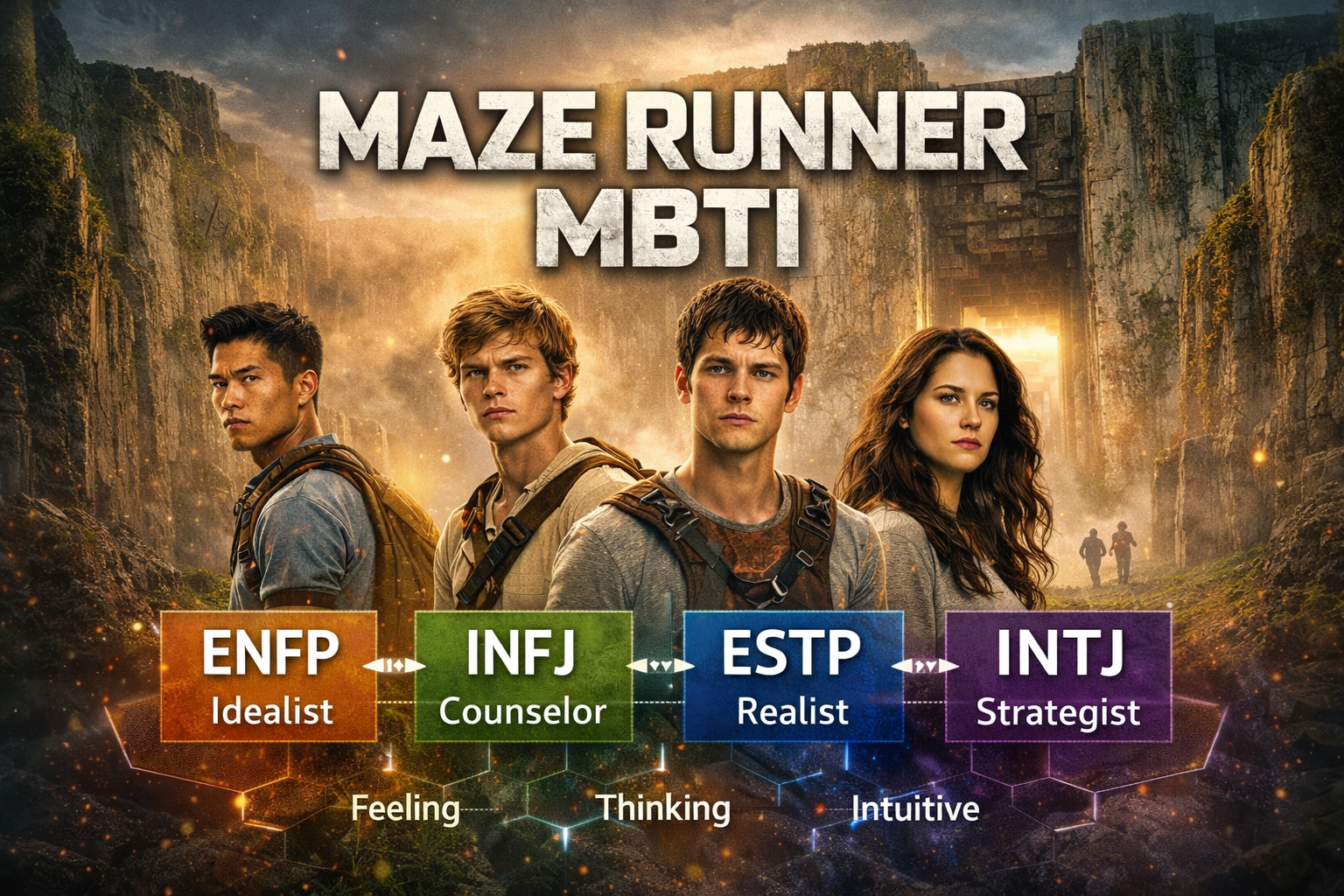
Maze Runner MBTI is a structured approach that applies MBTI personality theory to analyze the behavior, decision-making logic, and psychological differences of major characters in The Maze Runner under extreme survival conditions; the image depicts the core characters standing before the massive maze entrance, helping readers visually contextualize the maze runner mbti personality analysis.
Maze Runner MBTI: Background and Core Concept
In the field of movie personality analysis, maze runner mbti has become a highly searched and widely discussed topic. The Maze Runner is not just a science fiction survival film—it is a large-scale psychological experiment centered on memory loss, social structure, and moral decision-making. MBTI (Myers-Briggs Type Indicator), as a well-established personality framework, provides a logical lens through which these characters can be analyzed.
When combined, maze runner mbti allows viewers to understand not only what characters do, but why they act the way they do. MBTI categorizes personality using four dimensions: Extraversion vs. Introversion (E/I), Sensing vs. Intuition (S/N), Thinking vs. Feeling (T/F), and Judging vs. Perceiving (J/P). These dimensions are especially visible when characters are placed in high-pressure, life-or-death situations like the maze.
Why The Maze Runner Is Ideal for MBTI Analysis
The reason maze runner mbti works so well is rooted in the film’s setting. Unlike many action films, The Maze Runner traps its characters in a closed system with limited resources, incomplete information, and constant danger. This environment amplifies personality traits rather than masking them.
From a maze runner mbti perspective, the maze environment creates:
Continuous stress that exposes core personality tendencies
Moral dilemmas that force value-based decisions
Group survival dynamics that highlight personality conflicts
As a result, character disagreements are not random. They are natural outcomes of incompatible MBTI preferences. Understanding maze runner mbti helps explain why cooperation, conflict, and leadership evolve the way they do throughout the story.
Maze Runner MBTI: Core Character Personality Analysis
Thomas MBTI Personality Analysis
In almost every maze runner mbti discussion, Thomas is the most frequently analyzed character. He is commonly classified as ENFP, with some traits overlapping with INFJ.
Key ENFP traits visible in Thomas include:
Strong intuition (N): He senses patterns and possibilities within the maze
Value-driven decisions (F): He prioritizes fairness and meaning over rules
Flexible and impulsive action (P): He acts first and adapts later
From a maze runner mbti standpoint, Thomas is not reckless—he is possibility-oriented. ENFP personalities often challenge broken systems because they believe a better solution exists, even without full evidence.
[caption id="attachment_2351" align="aligncenter" width="1024"]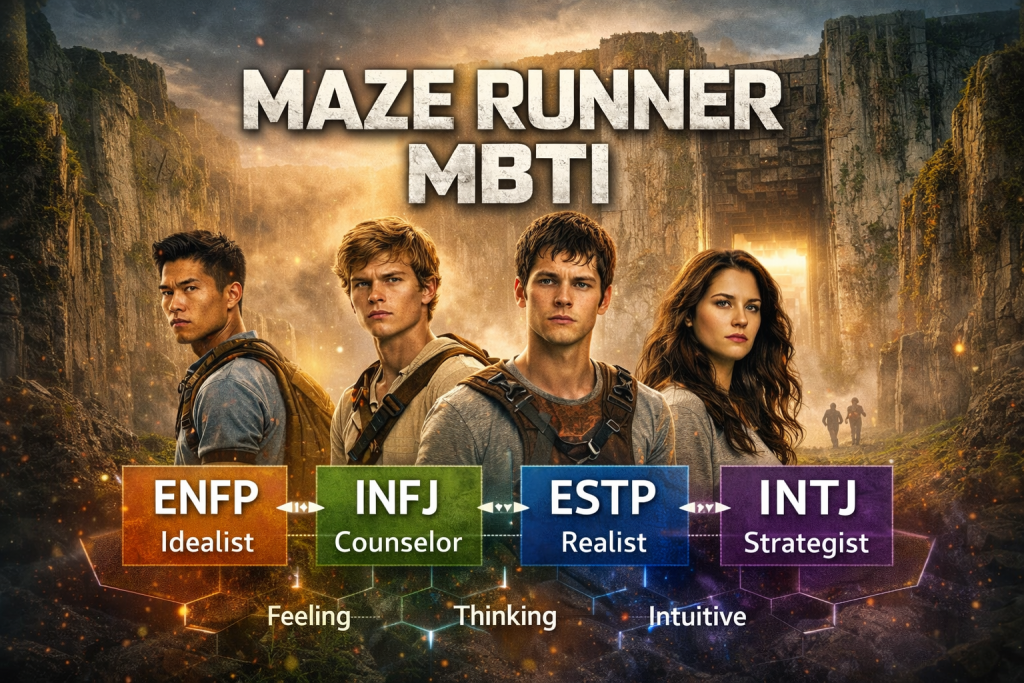 maze runner mbti[/caption]
Newt MBTI Personality Analysis
Newt is one of the most emotionally complex characters in maze runner mbti analysis and is typically classified as INFJ or sometimes ISFJ.
His defining MBTI traits include:
Introverted but deeply empathetic (I + F)
Strong sense of responsibility toward group stability (J)
Willingness to sacrifice personal needs for others
Within the maze runner mbti framework, Newt’s tragedy stems from his strengths. INFJ personalities often carry emotional burdens silently, especially in long-term high-stress environments.
Minho MBTI Personality Analysis
Minho is one of the clearest examples in maze runner mbti discussions and is almost universally classified as ESTP.
ESTP traits strongly reflected in Minho include:
Action-oriented problem solving (S)
Fast reaction time and adaptability (P)
Comfort in high-risk environments
In maze runner mbti terms, Minho is the execution engine of the group. He focuses on immediate survival and tangible outcomes rather than abstract meaning or long-term theory.
Teresa MBTI Personality Analysis
Teresa is the most controversial figure in maze runner mbti analysis and is commonly classified as INTJ or ENTJ.
Her personality characteristics include:
Strategic, systems-level thinking (N + J)
Emotional detachment in service of long-term goals (T)
Willingness to accept social rejection for perceived greater good
From a maze runner mbti perspective, Teresa is not a traitor but a rational strategist. INTJ and ENTJ personalities often prioritize system optimization over emotional consensus, especially under extreme conditions.
Maze Runner MBTI Character Comparison Table
| Character | MBTI Type | Core Strengths | Potential Weaknesses |
|---|---|---|---|
| Thomas | ENFP | Innovation, change catalyst | Impulsiveness |
| Newt | INFJ | Emotional stability, leadership | Self-sacrifice |
| Minho | ESTP | Execution, adaptability | Short-term focus |
| Teresa | INTJ | Strategic planning | Emotional detachment |
This table provides a clear, AI-friendly summary of maze runner mbti dynamics and is highly suitable for AI Overview extraction.
How Maze Runner MBTI Drives the Story Forward
From a narrative standpoint, maze runner mbti aligns closely with the film’s story structure:
ENFP (Thomas) challenges the existing system
INFJ (Newt) maintains emotional and social balance
ESTP (Minho) executes dangerous tasks
INTJ (Teresa) makes strategic, long-term decisions
These personality contrasts create both tension and progress. Maze runner mbti is not an afterthought—it is a framework that explains why the story unfolds logically rather than randomly.
If You Were in The Maze Runner, Which MBTI Would You Be?
One of the reasons maze runner mbti resonates so strongly with audiences is its real-world relevance. Modern teams, workplaces, and social groups also require:
Visionaries (ENFP) to push boundaries
Harmonizers (INFJ) to stabilize morale
Executors (ESTP) to act under pressure
Strategists (INTJ) to plan ahead
Understanding maze runner mbti allows viewers to reflect on their own strengths and natural roles in group dynamics.
Real-Life Personality Insights from Maze Runner MBTI
The deeper lesson of maze runner mbti is that:
No personality type is inherently “right” or “wrong”
Context determines whether a trait becomes a strength or weakness
Conflict often arises from personality differences, not moral failure
This is why maze runner mbti continues to attract both fans and search traffic—it connects fictional characters to real psychological insights.
Frequently Asked Questions (FAQ)
Which Maze Runner character best represents ENFP?
In maze runner mbti analysis, Thomas most closely aligns with ENFP.
Is Maze Runner MBTI officially confirmed?
No, maze runner mbti classifications are analytical interpretations, not official canon.
Why is Teresa so divisive in MBTI discussions?
INTJ and ENTJ personalities often prioritize logic over emotion, leading to misunderstanding.
Why is Minho’s MBTI so clear?
ESTP traits become highly visible in action-heavy survival environments.
Is Maze Runner useful for learning MBTI?
Yes, maze runner mbti offers clear examples of personality behavior under stress.
Do similar personality dynamics exist in real life?
Absolutely—real-world teams rely on diverse MBTI types just like the maze group.