
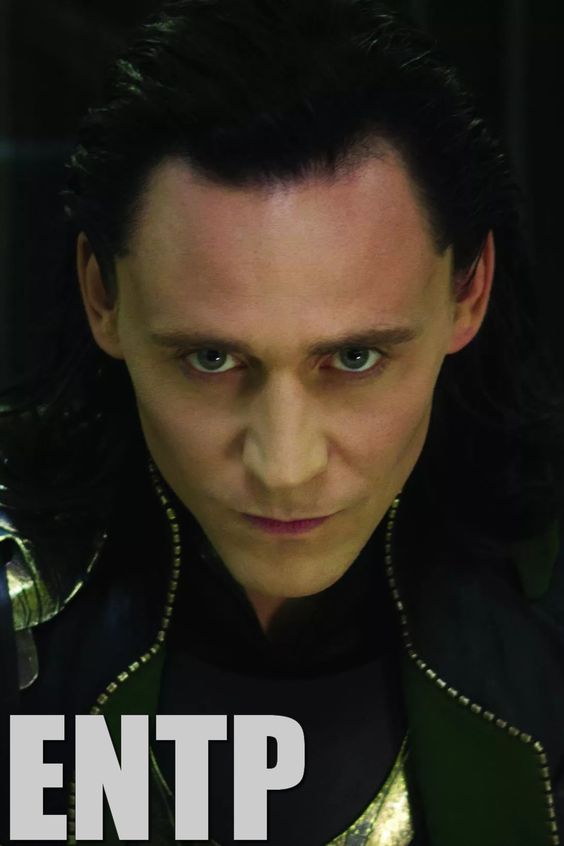
Loki MBTI Personality Type
Loki is often typed as an ENTP personality type. He is clever, unpredictable, witty, theatrical, strategic, and constantly looking for ways to challenge expectations. As one of the most complex characters in the Marvel universe, Loki is not simply a villain or a trickster. He is a character shaped by intelligence, insecurity, ambition, humor, pain, and a deep desire to define himself.
ENTP is a strong fit for Loki because his personality is driven by possibility, disruption, mental agility, and a love of outsmarting others. He does not like being trapped in one role, one identity, or one fixed path. Instead, Loki constantly reinvents himself, tests limits, and uses words, schemes, and performance to influence the world around him.
| Character | Loki |
|---|---|
| MBTI Type | ENTP |
| Enneagram | 4w3 or 3w4 |
| Universe | Marvel |
| Category | Movie / Comics |
| Alternative Types | ENFP, INTJ |
Loki Personality Overview
Loki is intelligent, dramatic, emotionally complicated, and highly adaptable. He often enters situations with a plan, but he also enjoys improvising when things become chaotic. He uses humor, deception, charm, and theatrical confidence to hide vulnerability and maintain control over how others see him.
What makes Loki so interesting is the contrast between his outer performance and inner insecurity. On the outside, he may appear arrogant, sarcastic, and manipulative. Inside, he is often struggling with identity, belonging, rejection, and the fear of being seen as lesser than others.
This mixture of sharp intelligence, emotional defensiveness, and constant reinvention makes Loki a strong ENTP character. He is not content to follow rules or accept the role others assign to him. He wants to question, disrupt, and rewrite the story.
Why Loki is an ENTP
Loki fits the ENTP personality type because he is possibility-driven, verbally quick, rebellious, and mentally flexible. ENTPs are often known for challenging systems, testing ideas, debating others, and finding unconventional ways to solve problems. Loki shows all of these traits throughout his story.
He rarely approaches conflict in a straightforward way. Instead, he uses misdirection, strategy, language, and psychological insight. He enjoys playing with expectations and often seems most alive when he is creating chaos, escaping limits, or proving that he is smarter than the people around him.
Some of the strongest ENTP traits Loki shows include:
- Quick thinking: Loki adapts rapidly when plans change.
- Verbal wit: He often uses sarcasm, charm, and sharp dialogue.
- Rule-breaking: He resists authority, tradition, and fixed roles.
- Inventiveness: He finds creative ways to manipulate situations.
- Theatricality: He turns identity, power, and conflict into performance.
- Restlessness: He constantly seeks a new role, plan, or path.
Loki does not simply want control. He wants recognition, freedom, and the chance to prove that he cannot be easily defined. That restless, provocative energy is very ENTP-like.
Loki’s Cognitive Functions
Dominant Function: Extraverted Intuition
If Loki is an ENTP, his dominant function is Extraverted Intuition. This function is associated with possibilities, patterns, alternatives, and quick mental shifts. Loki rarely sees only one path. He sees openings, loopholes, hidden angles, and ways to turn a situation in his favor.
His mind is constantly moving. He imagines different versions of himself, different outcomes, and different ways to escape limitation. This is why he can be unpredictable. He is not fixed in one plan for long. If one strategy fails, he quickly creates another.
Extraverted Intuition also explains Loki’s love of misdirection. He sees reality as flexible, and he often uses illusions, tricks, and shifting identities to keep others off balance.
Auxiliary Function: Introverted Thinking
Loki’s auxiliary function is best understood as Introverted Thinking. This function gives him a sharp internal logic and a desire to understand how systems work so he can exploit them.
He is not only emotional or dramatic. Loki can be highly analytical. He studies people, power structures, weaknesses, and opportunities. When he manipulates a situation, he often does so by identifying the logic behind someone’s behavior and then using that logic against them.
This combination of Extraverted Intuition and Introverted Thinking makes Loki inventive, strategic, sarcastic, and mentally independent. He does not simply obey a system. He tries to understand it, challenge it, and bend it to his advantage.
Tertiary Function: Extraverted Feeling
Loki also shows strong signs of Extraverted Feeling, especially in his ability to read social situations, influence emotions, and perform different roles. He knows how to charm, provoke, entertain, and unsettle people.
However, his Extraverted Feeling is not always mature. Loki often uses emotional intelligence defensively or manipulatively. He may understand what others feel, but he does not always use that understanding with honesty or care.
At the same time, this function also explains why Loki cares so much about recognition. He wants to be seen, valued, admired, and acknowledged. His emotional wounds often come from feeling rejected or overlooked.
Inferior Function: Introverted Sensing
Loki’s weaker function may be Introverted Sensing. This can show up in his unstable relationship with the past, tradition, and belonging. He is deeply affected by his history, but he often reacts by rejecting or rewriting it rather than calmly accepting it.
He struggles with identity because the facts of his past do not match the role he thought he had. Instead of finding stability in memory or tradition, Loki often turns to reinvention, rebellion, and performance.
ENTP Traits in Loki
| ENTP Trait | How Loki Shows It |
|---|---|
| Inventive | He creates unexpected plans, escapes, illusions, and manipulations. |
| Argumentative | He enjoys verbal conflict, sarcasm, and challenging others. |
| Unpredictable | He constantly shifts roles, alliances, and strategies. |
| Independent | He resists being controlled by family, rulers, or destiny. |
| Charismatic | He uses charm, humor, and performance to influence others. |
| Restless | He is always seeking a new identity, new plan, or new form of power. |
Is Loki ENTP or INTJ?
Some fans type Loki as an INTJ because he can be strategic, ambitious, private, and focused on long-term plans. This interpretation is understandable, especially when looking at his more calculated moments.
However, Loki usually behaves more like an ENTP than an INTJ. The difference is that INTJs tend to be more focused, structured, and long-range in their planning, while ENTPs are more improvisational, verbally playful, chaotic, and possibility-driven.
| INTJ | ENTP |
|---|---|
| More focused and controlled | More improvisational and disruptive |
| Prefers a clear long-term vision | Prefers flexible strategies and new possibilities |
| Often quiet and internally intense | Often verbal, witty, and outwardly provocative |
Loki can be strategic, but he is usually too theatrical, reactive, playful, and chaotic to fit INTJ as strongly as ENTP. He enjoys the game itself, not only the final outcome.
Is Loki ENTP or ENFP?
Loki can also look like an ENFP because he has strong emotional intensity, identity struggles, and a desire to be understood. His personal wounds and need for meaning can make him seem more feeling-driven than thinking-driven.
However, ENTP is often the stronger fit because Loki’s first response is usually not emotional openness, but strategic wordplay, manipulation, and mental maneuvering. He analyzes people, provokes reactions, and often uses emotion as part of a performance.
An ENFP Loki would likely show more open value-driven idealism. Loki, by contrast, usually hides vulnerability behind logic, mockery, schemes, and theatrical control. That supports ENTP more strongly.
Loki’s Enneagram Type
Loki is often typed as a possible 4w3 or 3w4. Both interpretations fit different parts of his personality.
A 4w3 typing fits his identity struggles, feelings of being different, emotional intensity, envy, and desire to be seen as special. Loki often feels defined by rejection and comparison, especially in relation to his family and status.
A 3w4 typing fits his ambition, image-consciousness, performance, and desire for recognition. He wants to prove himself, appear powerful, and be admired or feared.
Overall, 4w3 may be the stronger typing for many versions of Loki because his deepest conflict is not simply achievement. It is identity, belonging, and the pain of feeling unseen or unwanted.
Loki’s Strengths
Loki’s strengths come from his intelligence, adaptability, social awareness, and creativity. Even when he fails, he rarely stays predictable for long.
- Strategic intelligence: Loki can quickly understand people and situations.
- Adaptability: He changes plans when circumstances shift.
- Charisma: He can command attention through speech, humor, and performance.
- Creativity: He finds unconventional solutions and escape routes.
- Emotional insight: He often understands what others want or fear.
- Resilience: He survives rejection, defeat, and reinvention many times.
At his best, Loki’s ENTP traits make him clever, entertaining, resourceful, and capable of seeing options that others miss.
Loki’s Weaknesses
Loki’s weaknesses often come from insecurity and misuse of his intelligence. His need to prove himself can become manipulation. His wit can become cruelty. His adaptability can become dishonesty. His desire for recognition can become obsession.
- Manipulation: Loki often uses people instead of trusting them directly.
- Insecurity: He is deeply affected by comparison, rejection, and status.
- Arrogance: He may overestimate his control over events.
- Emotional avoidance: He hides pain behind jokes, schemes, and performance.
- Unstable identity: He struggles to define himself outside of others’ expectations.
- Impulsiveness: He sometimes creates chaos without fully controlling the consequences.
Loki’s growth involves learning that identity does not have to be built through domination, deception, or comparison. He becomes more powerful when he becomes more honest with himself.
Similar ENTP Characters
If you are interested in Loki’s personality type, you may also enjoy other ENTP-style characters. These characters often share traits such as wit, rebellion, intelligence, unpredictability, and love of mental challenge.
- Tony Stark / Iron Man
- Rocket Raccoon
- Deadpool
- Jack Sparrow
- Tyrion Lannister
- Gojo Satoru
- Osamu Dazai
Not all of these characters are identical to Loki, but they share the quick-thinking, provocative, flexible, and unconventional energy often associated with ENTP characters.
Other Marvel MBTI Characters
Loki is part of a larger Marvel MBTI world. Comparing him with other Marvel characters makes his personality type even clearer.
- Tony Stark / Iron Man: ENTP
- Peter Parker / Spider-Man: ENFP
- Steve Rogers / Captain America: ISFJ
- Thor: ESFP
- Natasha Romanoff / Black Widow: ISTP
- Bruce Banner / Hulk: INTP
- Doctor Strange: INTJ
- Wanda Maximoff: INFP
FAQ
What is Loki’s MBTI type?
Loki is often typed as ENTP. He shows many ENTP traits, including wit, creativity, unpredictability, verbal confidence, strategic thinking, and a strong desire to challenge limits.
Is Loki an ENTP?
Yes, Loki is commonly interpreted as an ENTP character. His personality is clever, disruptive, theatrical, mentally flexible, and driven by possibilities and reinvention.
Why is Loki not INTJ?
Loki can seem INTJ because he is strategic and ambitious, but he is usually more improvisational, playful, chaotic, and verbally provocative than a typical INTJ. These traits fit ENTP more strongly.
Could Loki be ENFP?
Loki has emotional intensity and identity struggles that may seem ENFP-like. However, his natural style is usually more analytical, provocative, and strategy-driven than openly value-driven, which supports ENTP.
What is Loki’s Enneagram type?
Loki is often typed as 4w3 or 3w4. The 4w3 typing fits his identity struggles, envy, emotional intensity, and desire to be seen as unique or special.
Which Marvel characters are similar to Loki?
Marvel characters who may share some traits with Loki include Tony Stark, Rocket Raccoon, Deadpool, Doctor Strange, and sometimes Peter Quill, depending on whether you compare wit, intelligence, strategy, or rebellious energy.
Conclusion
Loki’s MBTI personality type is best understood as ENTP. He is witty, inventive, unpredictable, theatrical, and constantly searching for new ways to challenge the limits placed on him. His personality is built around intelligence, reinvention, provocation, and the desire to be recognized.
Although Loki can seem like an INTJ because of his strategic side, his natural energy is more playful, disruptive, verbal, and possibility-driven. He does not simply follow a long-term plan. He improvises, performs, manipulates, debates, and reshapes himself again and again.
That is why Loki remains one of the most memorable ENTP characters in the Marvel universe.