
Want to better understand yourself or that one friend who’s always checking in on everyone? This article dives into the personality profile ESFJ to help you decode this “social expert” personality type—and if you’re an ENTP, it’ll help you find that sweet spot of connection with them. Nothing too technical here, just a relaxed conversation about personality, relationships, and growth.
Personality Profile ESFJ: Understanding the Secrets of a Social Expert
Do you have that one friend who always plans the group outings, remembers your coffee order (extra sugar, no milk), and checks in when your texts feel off? Chances are, they’re an ESFJ—MBTI’s “Consul” or “Supportive Host” personality type. They’re warm, dependable, and often the glue that holds a social group together.
An ESFJ personality profile breaks down into four traits: Extraversion (E), Sensing (S), Feeling (F), and Judging (J). That means they thrive on interaction, prefer concrete details, lead with empathy, and love structure.
3 Clear Traits That Define ESFJs
- Masters of Emotional Radar
They pick up on subtle mood shifts—your “just okay” reply might trigger a heartfelt “Are you really okay?” message. Their attention to emotional nuance is impressive. - Structure-Lovers
ESFJs crave order. Whether it’s trip planning or team meetings, they like knowing what’s happening, when, and who’s in charge of what. - Social Harmony Keepers
They don’t just enjoy socializing—they thrive on it. ESFJs are usually the ones making sure everyone feels seen and included in a group setting.
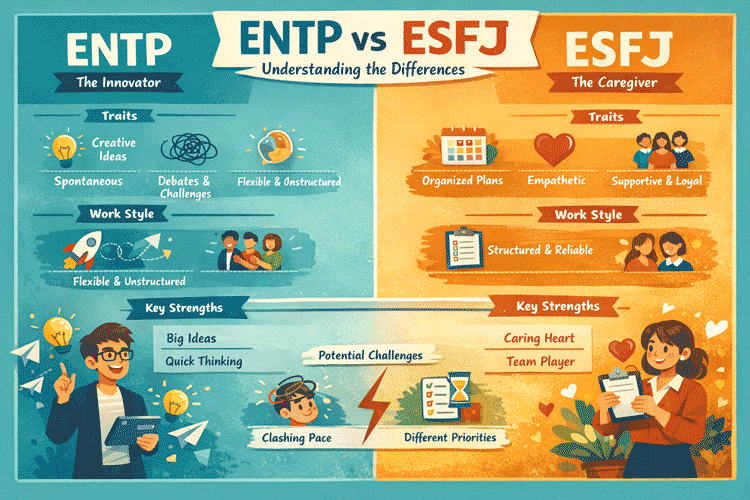
A Quick Analogy: The Class Event Coordinator
If you’re the ENTP with 10 wild ideas and zero patience for timelines, the ESFJ is the reliable planner making sure those ideas turn into reality. Think of them as the class event coordinator—detail-oriented, people-focused, and always prepared.
MBTI ENTP Profile: Do You Really Know Yourself?
As an ENTP, you’ve likely heard things like, “You think so fast!” or “You always have a new idea!”—and maybe also, “Are you ever going to finish that project?” Classic ENTP behavior. You’re energetic, full of ideas, and allergic to repetition.
An ENTP personality profile includes Extraversion (E), Intuition (N), Thinking (T), and Perceiving (P). In simpler terms: social, imaginative, analytical, and spontaneous.
3 Quick Ways to Spot an ENTP
- Idea Generator Mode On
You can brainstorm five different approaches to a problem in under 10 minutes—but may not want to stick with any of them. - Rules? What Rules?
You resist rigid schedules and love flexibility. Repetition is your enemy. - Chaos-into-Logic Translator
You thrive in ambiguity, connecting dots others don’t even see.
Analogy Time: Talk Show Host Meets Startup Founder
Think Trevor Noah meets Elon Musk—you can charm a room and pitch a vision all in the same breath. But structure? That’s… optional. And that’s where learning from ESFJ types can really help ground your energy.
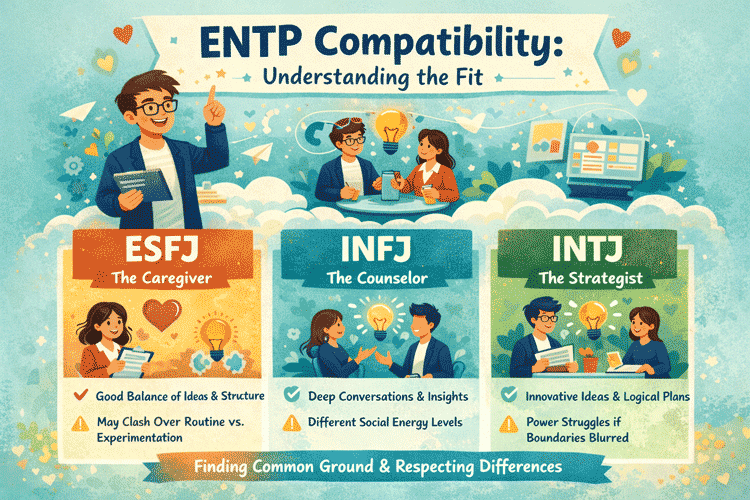
ENTP and ESFJ, INFJ, INTJ: Compatibility and Contrast
ENTP & ESFJ: Opposites Can Attract (and Clash)
ESFJs are emotional organizers; ENTPs are creative improvisers. The result? Mutual fascination or friction. ESFJs bring calm and structure, which ENTPs often need. But ENTPs might feel smothered by too much routine.
ENTP & INFJ: Deep, Quiet Connection
INFJs are introspective idealists. ENTPs bring out their curiosity and INFJs ground ENTPs with emotional depth. The challenge lies in syncing pace: INFJs need time to process, while ENTPs leap from idea to idea.
ENTP & INTJ: Brainstorm + Blueprint
INTJs plan. ENTPs provoke. It can be a power duo or a power struggle. INTJs demand direction; ENTPs seek options. When balanced, it’s a brilliant combo.
ESFJ Personality in the Workplace: What ENTPs Can Learn
In the workplace, personality differences matter. ENTPs are fast-paced, idea-driven thinkers. ESFJs are detailed, people-oriented organizers. Together, they can either thrive—or tread on each other’s nerves.
Common Friction Points Between ENTPs & ESFJs
ENTPs love spontaneity. ESFJs prefer predictability. This difference can spark tension in team dynamics. The trick? Communicate expectations clearly and respect each other’s strengths.
Best Work Environments for ENTPs
- Creative Fields – Advertising, media, design
- Entrepreneurial Spaces – Startups, innovation hubs
- Strategic Roles – Consulting, product development
ENTP Pitfalls to Avoid at Work
- Jumping between projects without follow-through
- Disrupting team flow with constant pivots
Personal Growth for ENTP: Ideas Are Great, But Action Wins
Having ideas is easy for you. Making them stick? That’s the growth edge.
3 Habits to Boost Focus
- Pomodoro method – 25 mins focus, 5 mins break
- 3-item daily to-do list – Keep it simple
- Time-box creative thinking – Don’t brainstorm forever
Sharpen Emotional Awareness
Logic gets you far, but empathy takes you further. Pause before responding, especially with feeling-oriented types like ESFJs and INFPs.
Ground Your Ideas in Action
- Break each idea into 3 concrete steps
- Assign a deadline to each step
Consistency turns vision into impact.
MBTI Type Comparison: Beyond ESFJ, Who Else Should You Know?
INFP: The Gentle Idealist
Dreamy, empathetic, and sometimes too slow-paced for you. But INFPs bring deep emotional wisdom that can balance your energy.
ENTJ: Fellow Challenger, Possible Rival
ENTJs are goal-oriented and dominant. When two strong minds collide, either magic happens—or someone storms out of the meeting. Set boundaries and share the lead.
ISFP & ESTJ: Quiet Support vs Commanding Structure
ISFPs might seem passive, but they’re loyal and observant. ESTJs are organized and direct, maybe too direct for your taste. Still, they’re solid teammates.
Quick Guide: How to Tell If You or Your Friend Is an ENTP
- Take a free MBTI test (e.g., 16personalities.com)
- Ask: Do I love starting things more than finishing them?
- Notice: Do I thrive in fast-paced conversations and idea swaps?
Final Thoughts
Understanding the personality profile ESFJ is more than a curiosity—it’s a window into your relationships, especially as an ENTP. You bring energy, ideas, and adaptability. ESFJs offer support, structure, and care. You may move at different speeds, but when you sync up, the combination is unstoppable.
MBTI isn’t about putting people in boxes. It’s about appreciating differences and finding better ways to connect. If this guide helped you see yourself—or someone else—more clearly, share it with a fellow personality explorer.
FAQ About Personality Profile ESFJ
Q1: What does personality profile ESFJ mean in MBTI?
A:
The personality profile ESFJ refers to individuals who are Extraverted, Sensing, Feeling, and Judging. They are known for being caring, loyal, social, and organized. Often called “The Consul” or “Supportive Host,” ESFJs are excellent at maintaining harmony and helping others.
Q2: How is an ESFJ different from an ENTP?
A:
ESFJs are structured, emotionally intuitive, and prioritize group harmony, while ENTPs are spontaneous, idea-driven, and thrive on intellectual stimulation. ESFJs seek stability; ENTPs crave change. Their strengths can be very complementary if mutual understanding is present.
Q3: What careers suit ESFJ personalities?
A:
ESFJs do well in people-centered, organized environments like teaching, healthcare, HR, event planning, and customer service. They thrive when they feel useful and appreciated in structured settings.
Q4: Are ESFJs good partners in relationships?
A:
Yes! ESFJs are attentive, loyal, and emotionally supportive. They value tradition and are often committed to long-term relationships. Their challenge lies in sometimes putting others’ needs above their own, so balance is key.
Q5: How do I know if I or my friend is an ESFJ?
A:
Common signs include remembering personal details about others, being the go-to person for organizing group activities, enjoying helping others, and seeking harmony in social situations. Taking a reliable MBTI test can offer further insight.